
The 7 June Transposition Deadline: What Changes on Day One in Ireland (and What Doesn't)
← Blog
Key Takeaways
Nothing new binds private employers yet. A directive cannot be enforced against private employers before transposition, so none of the Directive's obligations bind you today. That includes its reversal of the burden of proof, which arrives with the transposing legislation and not with the deadline.
Penalties are deferred. The equal pay rules you already have are not. The Department of Children, Disability and Equality confirms no penalties for incomplete implementation, but section 85A of the Employment Equality Act 1998 has always put the onus on the employer once a worker makes out a prima facie case. The Irish Congress of Trade Unions has argued a valid claim could be backdated to 7 June 2026, which remains an untested position.
Hiring transparency waits on the Equality (Miscellaneous Provisions) Bill. It carries the salary history ban Ireland and mandatory salary bands in job advertisements. It is not yet law, despite clearing scrutiny in October 2025.
The heavy lifting waits on the separate Pay Transparency Bill which remains unpublished. It carries the right to information, the end of pay secrecy clauses, work of equal value job mapping and the joint pay assessment as well as the penalties that will apply.
Your 2026 reporting has not changed. Gender pay gap reporting Ireland 2026 under the Gender Pay Gap Information Act 2021 still needs a June snapshot and November publication which is now mandatory through the central portal.
Treat the delay as build time. Audit total remuneration, fix recruitment and rebuild your job architecture before the first EU-compliant reports fall due on 7 June 2027.
The 7 June 2026 transposition deadline for the EU Pay Transparency Directive in Ireland passed with the domestic position incomplete. The stand-alone Pay Transparency Bill is unpublished. The Equality (Miscellaneous Provisions) Bill, which carries the pre-employment rules, cleared pre-legislative scrutiny in October 2025 and sits with officials. DCDE confirmed Ireland would miss full transposition and will roll the Directive out on a phased basis, with no penalties for the missing elements. For the full picture on the EU Pay Transparency Directive (EUPTD), see our complete guide to the EU Pay Transparency Directive.
Here is the trap. A delayed Bill looks like permission to do nothing. It is not. The Directive's new duties wait on the Oireachtas; the equal pay law already on the statute book does not, and the groundwork behind those duties takes far longer than the Bills will.
Day One: What Actually Took Effect on 7 June
For private employers in Ireland, nothing did. A directive cannot be enforced directly against a private employer before transposition, so the Directive's new obligations do not bind: pre-employment transparency, the right to information, expanded reporting, the joint pay assessment and the reversal of the burden of proof all wait on domestic legislation.
That last item is the one most often misstated, including in commentary published around the deadline. Article 18 of the Directive strengthens the burden of proof in pay discrimination claims, most sharply by putting the employer to proof where it has failed its own transparency duties. That is an instruction to member states. It reaches private employers when the Pay Transparency Bill enacts it, not when the deadline expires. Passing 7 June did not switch it on.
What did not change, because it was already there, is Ireland's existing burden shift. Section 85A of the Employment Equality Act 1998 puts the onus on the employer to disprove discrimination once a worker establishes facts from which it may be presumed. An equal pay claim taken to the Workplace Relations Commission (WRC) tomorrow runs on that footing, and answering it still means demonstrating that your pay structures rest on objective and gender-neutral criteria. The evidentiary problem is the same one the Directive is designed to sharpen; it is simply not new.
Two qualifications sit on top of that. Now that the deadline has passed, a WRC adjudicator must interpret existing equality law consistently with the Directive's objectives so far as domestic law permits, although that duty cannot be stretched into enforcing the Directive's new thresholds and reporting duties against a private employer. Separately, workers employed by the State or an emanation of the State may be able to rely on sufficiently clear provisions of the Directive directly. The Irish Congress of Trade Unions has said a worker with a valid claim could seek redress backdated to 7 June 2026: worth watching, but a contested position rather than settled law.
The Phased Rollout: What Comes With Each Bill
The rest of the transposition splits across two Bills, neither yet enacted. The Equality (Miscellaneous Provisions) Bill handles pre-employment transparency and the separate Pay Transparency Bill handles everything else. This is the phased rollout that pay transparency in Ireland is following.
The Equality (Miscellaneous Provisions) Bill: hiring transparency first
These will come into effect once the Bill is enacted, which has not happened despite scrutiny completing in October 2025:
Salary history ban Ireland-wide. You can no longer ask candidates what they currently earn or have earned. This is a process change you can make today, ahead of commencement.
Mandatory salary bands in job advertisements. Pay ranges must appear in the advert or reach candidates before interview. Vague "competitive salary" wording will not cut it.
The Pay Transparency Bill: the structural mandates
Still unpublished in draft, this Bill carries the elements behind most of the delay:
The individual right to information. Your employees can request average pay levels by gender for categories of workers doing the same work or work of equal value. With any number of staff, you must answer within the two-month window the Directive sets, using the equal-value categories below.
The end of pay secrecy clauses. Contractual terms stopping staff from discussing pay become unenforceable. This travels with the right to know, so it arrives with the wider transposition, not on 7 June.
Work of equal value job mapping. You must group the workforce into categories of equal value, scored on gender-neutral criteria (skills, effort, responsibility and working conditions). The Government's gender-neutral job evaluation toolkit only landed at the end of March 2026. Look at the EIGE toolkit on how to assess work of equal value.
The joint pay assessment. Where an unexplained gender pay gap above 5% sits in a category of work for 6 months without remediation, you must run a formal joint pay assessment with worker representatives and fix it. This will involve penalties for not resolving it and personal damages for non-remediated offences.
The reversed burden of proof. Article 18 arrives with this Bill rather than with the deadline. Once commenced, an employer that has not met its transparency duties will have to prove the absence of discrimination, and the documentation you can produce on the day becomes the whole of your defence.
Here is the Irish catch. Our industrial relations model is voluntarist and formal employee representation is thin across much of the private sector. Standing up a representative framework that can run a joint pay assessment is a large undertaking, not a box-tick.
One definition worth pinning down:
Pay means everything, not just salary. It covers bonuses, pensions, share options, allowances, health insurance and benefits in kind. Diagnose on base pay alone and you are measuring the wrong number.
The 2026 Compliance Timeline
Your gender pay gap reporting duties in Ireland for 2026 under the Gender Pay Gap Information Act 2021 are untouched by the Directive delay.
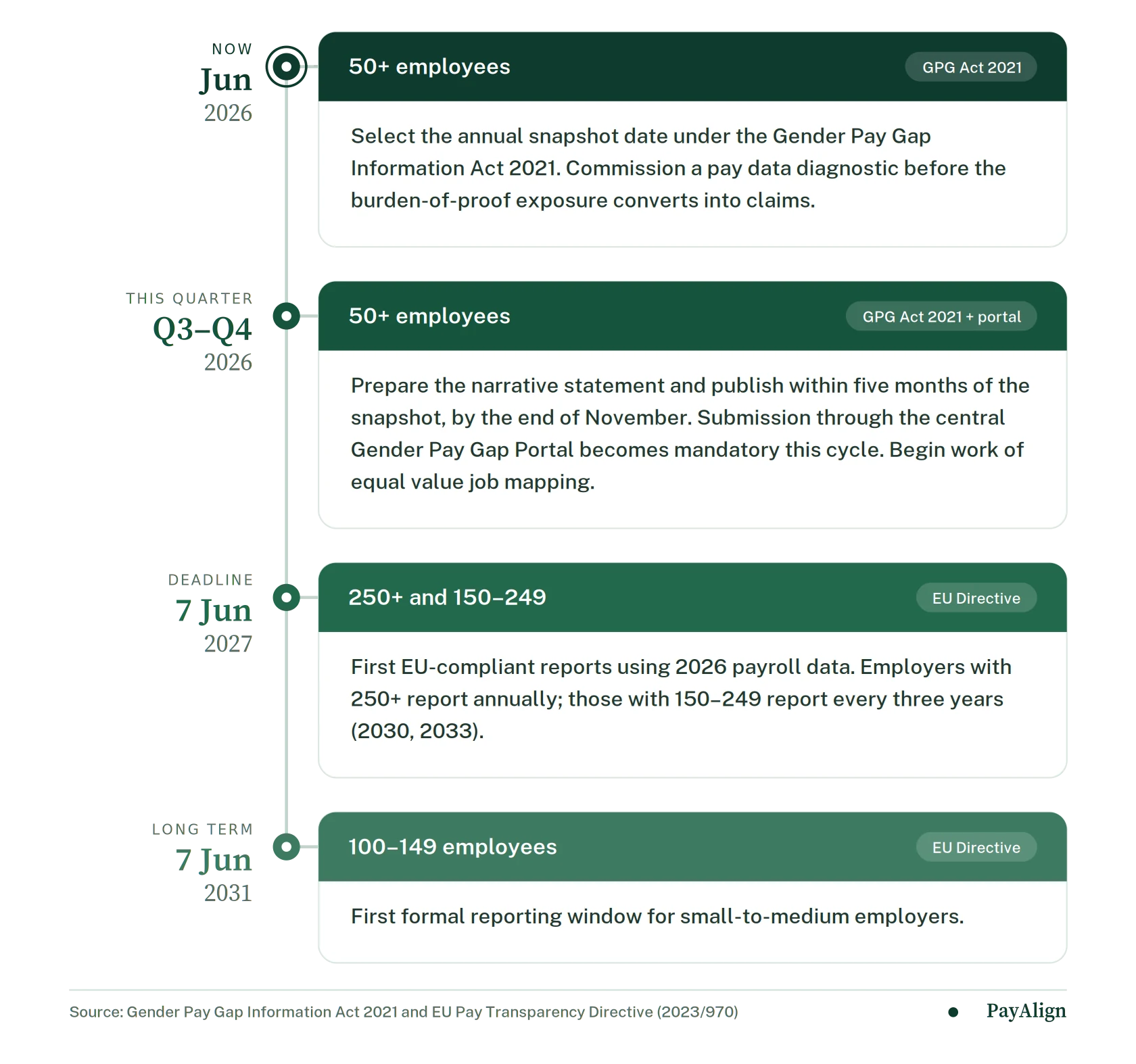
Under 100 staff? No EU reporting obligation, but Ireland's domestic baseline already bites at 50 or more, so expect the thresholds to drop in later phases.
Preparation: Use the Runway
The delay is runway, not relief. The employers who sail through the 2027 cycle are the ones treating the rest of 2026 as build time. Three priorities deserve budget now:
Run a holistic pay diagnostic across total remuneration, not base salary, to catch any unexplained gap before it becomes a claim.
Fix talent acquisition so recruiters drop salary-history questions and publish pay ranges.
Rebuild your job architecture on gender-neutral criteria. This mapping underpins everything that follows: the right to information, your worker categories and the 5% trigger.
That work cannot be done at the last minute. The window to 7 June 2027 is the cheapest chance to test your job architecture and pay frameworks against the Directive.
How PayAlign Helps You Prepare
PayAlign turns raw payroll data into a defensible, audit-ready compliance position. Gender pay gap reporting, equal value mapping and the joint pay assessment workflow, built for Irish employers and the EU Pay Transparency Directive. In a tight labour market, transparent pay is becoming a hiring advantage, not just a legal box. Book a demo to run a payroll snapshot through the platform and review your gap with the draft narrative already written.
Frequently Asked Questions
Does the EU Pay Transparency Directive apply in Ireland if the legislation is delayed?
Not to private employers. A directive cannot bind them before transposition, and that includes the Directive's reversal of the burden of proof, which arrives with the Pay Transparency Bill. Two things do apply in the meantime. Section 85A of the Employment Equality Act 1998 already shifts the onus to the employer once a prima facie case is made, and now that the deadline has passed the WRC must read existing equality law in line with the Directive so far as it can. DCDE has confirmed there are no penalties for incomplete implementation.
Is the salary history ban in Ireland in force yet?
Not yet. It sits in the Equality (Miscellaneous Provisions) Bill, which cleared pre-legislative scrutiny in October 2025 but is not enacted. That Bill also carries mandatory salary bands in job advertisements. Pulling salary-history questions out of recruitment now is a sensible, low-cost head start.
Do I still need to complete gender pay gap reporting in 2026?
Yes. Gender pay gap reporting Ireland 2026 under the Gender Pay Gap Information Act 2021 is unaffected by the delay. If your business has 50 or more staff, pick a June snapshot date and publish your data and report by the end of November. This is now mandatory through the central portal.
When is the first EU-compliant gender pay gap report due in Ireland?
Large employers (250+) and medium employers (150–249) file their first EU-compliant report by 7 June 2027 on 2026 data. 250+ reports annually, 150–249 every three years. Employers with 100–149 reach their first window on 7 June 2031.
Ready to see PayAlign in action?
In a 45-minute demo we'll run an actual payroll snapshot through the platform and show you the gap, live, with the draft narrative already written.
Book a demo →